March 31, 2026
Fix These 5 Tableau Dashboard Mistakes Today

These 5 Tableau dashboard mistakes can make your work look cluttered, confusing, and beginner-level fast. In this video, I break down the 5 biggest mistakes new Tableau users make and show you how to fix them so your dashboards look cleaner, more professional, and easier to use.
Download the practice workbook from this video here.
If you’re learning Tableau dashboard design, this video will help you avoid common problems like misusing colors, adding too many charts, ignoring your audience, overcomplicating layouts, and forgetting interactivity. These simple dashboard design tips will help you build cleaner, more actionable dashboards that feel less like data dumps and more like real business tools.
What we’ll cover:
- Misusing Colors, avoid the “Skittles Effect” and highlight what matters
- Chart Overload, use the Rule of 4 for cleaner dashboards
- Ignoring Your Audience, build for stakeholder decisions, not personal preference
- Container Chaos, why simple layouts beat overbuilt designs
- Functionality Fails, improve filter actions and remove distracting defaults
March 9, 2026
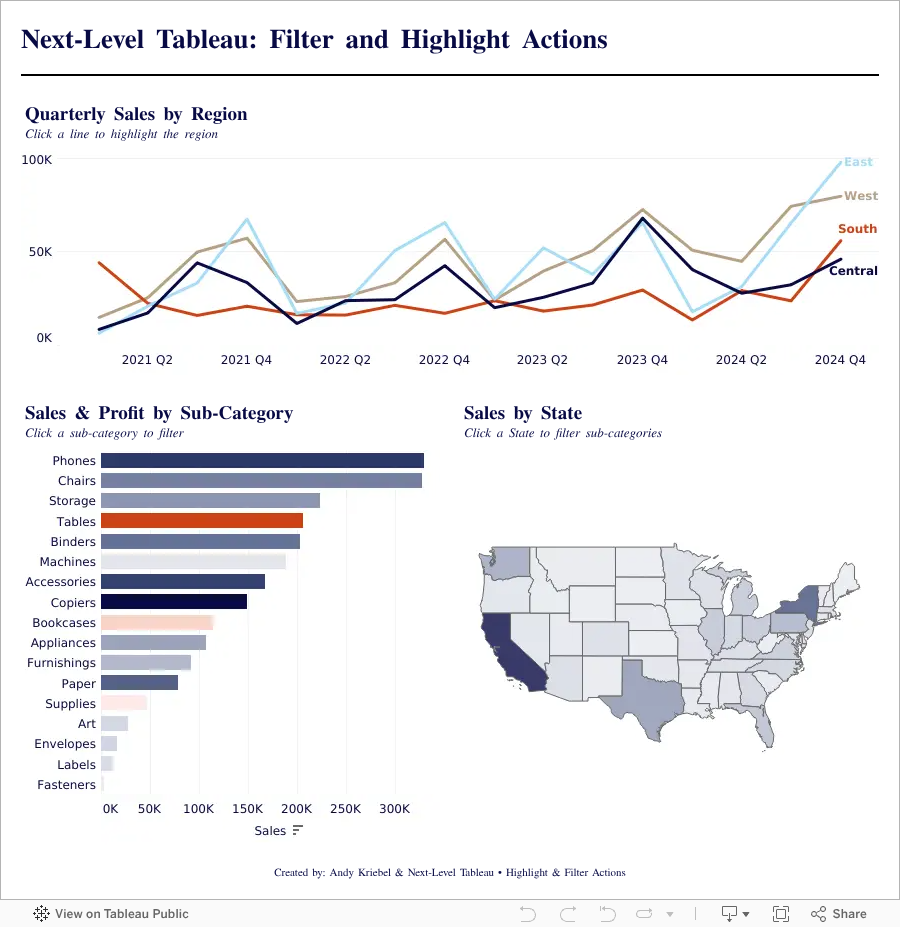
Highlight vs Filter Actions in Tableau: When Should You Use Each?

Highlight vs Filter Actions in Tableau can completely change how users interact with your dashboards. In this tutorial, you’ll learn the difference between highlight actions and filter actions, when to use each one, and how to build both into a Tableau dashboard from start to finish.
Using a practical end-to-end example, we’ll create charts, assemble them into a dashboard, and add interactive actions that improve usability and analysis. By the end, you’ll understand how highlight actions guide attention, how filter actions change the view, and how to use both together to create more effective Tableau dashboards.
Whether you’re new to Tableau dashboard actions or looking to sharpen your skills, this walkthrough will help you build more interactive and user-friendly dashboards with confidence.
February 25, 2026
How to Build a Quadrant Chart in Tableau | Step-by-Step Tutorial

In this lesson, I walk through how to build a quadrant chart (4-quadrant scatterplot) in Tableau.
Quadrant charts are one of the most effective ways to compare performance across two measures and quickly identify outliers, opportunities, and risk areas.
In this example, we’re analyzing:
- Profit Ratio
- Average Discount
At first glance, a scatterplot shows the relationship.
But once you add quadrant segmentation, the insight becomes much clearer.
You can instantly see:
- High profit / Low discount performers
- High profit but heavily discounted items
- Low profit / Low discount products
- Low profit / High discount problem areas
Inside the video, I’ll walk you through:
- Creating a Profit Ratio calculation
- Building the base scatterplot
- Adding average reference lines
- Splitting the view into four quadrants
- Categorizing marks based on performance
- Two different ways to build the quadrant chart
This is a foundational analysis technique you can apply to product performance, customer segments, sales teams, marketing channels, and more.
Download the Workbook + Dataset
You can download the workbook and dataset used in this lesson here:
👉 https://nlt.kit.com/quadrant
If you want to go deeper than individual chart techniques, this is exactly the kind of real-world training we focus on inside Next-Level Tableau.
Live classes.
Real use cases.
Advanced techniques you can apply immediately.
Learn more here:
👉 https://www.nextleveltableau.com/
February 18, 2026
How to Use Split, Custom Split, and Replace in Tableau